
In Praise of...Max Geldray's Harmonica
The happiest 3 minutes on the BBC World Service

The world currently seems to be overflowing with misery and cynicism (not without justification, but here we are.) As Kurt Vonegutt (a man who knew a thing or two about suffering and coming out the other side optimistic) said, “if this isn’t nice, then what is?” So in his spirit, I want to write positively about something each week. It’s too tempting for me to splash my anxiety about rising authoritarianism, climate crisis or sociopathic tech bros all over social media. Instead, I’m want to celebrate the little bits that make life worth living…
I am 8 years old, in the back seat of my Dad’s car on the way to Liverpool, which seems to be 750 miles away. Luckily my boredom is being machine-gunned to smithereens by the controlled lunacy coming out of the car speakers. I am 8 years old and my Dad has introduced me to the Goon Show.
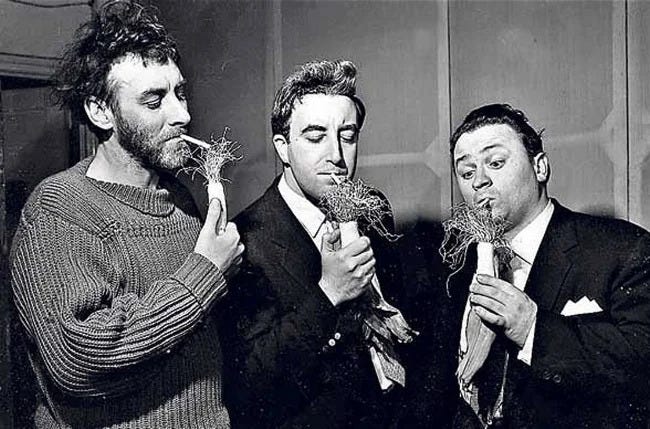
No doubt I can (and will) write another post about the literate bedlam and rich fool’s logic that powered the show, but if I had to pick the part that still makes me feel warm, safe and content, it is the musical interludes from Ray Ellington and Max Geldray.
This is probably just chance, but Geldray was Dutch and Jewish, while Ellington grew up where I now live in South London and also had a Jewish mother. No wonder the music speaks to me! They fit the show so perfectly, both supported by the powerhouse BBC orchestra conducted by Wally Stott1. Ellington mixed jazz and swing with hugely charismatic, funny performances. Geldray was also backed by the band, playing the much maligned harmonica. Perhaps previous generations more plagued by buskers and without the facility of bedroom studios had more to complain about, but I’ve always loved the harmonica. There’s not a grand selection of renowned players, but whether it’s Dylan’s turbo-Hoover technique or Stevie Wonder producing pure sunshine from his lips, I’ve always loved it.
Geldray was something else though. It takes supreme confidence and skill to have a couple of rows of brass and a thunderous drummer propelling you along when all you have in your hands is a sliver of metal. The BBC Dance Orchestra had the punchiness I love in that genre of which Count Basie was the king - another great musical jester making daffodils spring up wherever his light fingers touched the keyboard. At its best, that sort of big band jazz can have the dynamic of great rock or lean punk. Seriously. The quiet bit, loud bit dynamic on The Atomic Mr Basie is unparalleled. You know what he’s going to do and it delights you all the same. So it is with Geldray, bobbing and weaving between the startling stings of the trumpets before sailing away in a corkscrew of melodic light. He bends notes, splutters semi-quaver runs and launches his harmonica towards seemingly insurmountable peaks. It’s a musical performance that always has its sharpest suit on, shiny shoes and a plump carnation in its buttonhole.
So much of the Goon Show’s scripts can be analysed as Milligan’s already overactive and fragile mind trying and failing hilariously to process the horrors of the Second World War. It is all the more remarkable that Geldray suffered terribly as well, yet was able to produce three-minute jewels of uplifting melody and improvisation. He was injured in the Normandy landings and on returning to Amsterdam discovered that both his parents and his sister had been killed in concentration camps. To find the reserves of strength and optimism to keep going at all, never mind share music so full of puppyish enthusiasm is nothing short of superhuman. This is all information I have found out recently. Geldray’s music already felt like sitting on the most comfortable sofa at your grandparent’s house, beaming at their stories without it, but knowing the depths and heights of his life experience adds a whole new dimension.
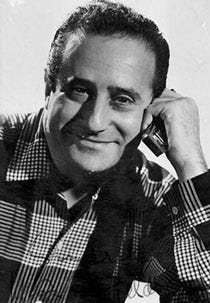
Geldray’s songs would always come first in the show, landing the audience back to Earth after Milligan, Sellers and Seacombe’s opening salvo. He couldn’t match their energy or comedy, but he can match their sense of playfulness. He manages it every time and it never feels like an intrusion. Even as a kid impatient to hear more larking about by my favourite idiots, I treasured the songs, to the extent that I can quote the melodies as easily as I can quote the jokes.
It is musical entertainment entirely of its time and somehow not dated. It probably helps that one of Spike’s favourite sound effects was a wheezing old gramophone record from a bygone era, but while so many pre-rock’n’roll entertainers can seem tired and hackneyed, Geldray’s harmonica remains full of unrestrained joy. Not a single cobweb could survive a blast from his instrument It’s made all the more charming on the very few moments when you hear Geldray speak and he seems to be the classic musician profile of a quiet man who prefers to talk through his instrument.
His core musical message, is that life contains bursting joy, endless play and has high notes worth hitting. Worth remembering and worth praising.
I have just done a quick Wikipedia search of Wally Stott to check the spelling of her name and discovered that Wally Stott became Angela Morley - a musical titan who was the first transgender person to be nominated for an Academy Award. Given the unending wave of shite trans people are having to put up with these days, it is heartening and illuminating to read about a trans person thriving in the 70s and 80s. Obviously she struggled with anxiety about living her authentic life, but from what I’ve read she was accepted by luminaries such as John Williams and Shirley Bassey, as well as Geldray himself. The whole entry is worth 10 minutes of your time to find out about a prolific person who was front and centre in UK entertainment: https://en.wikipedia.org/wiki/Angela_Morley